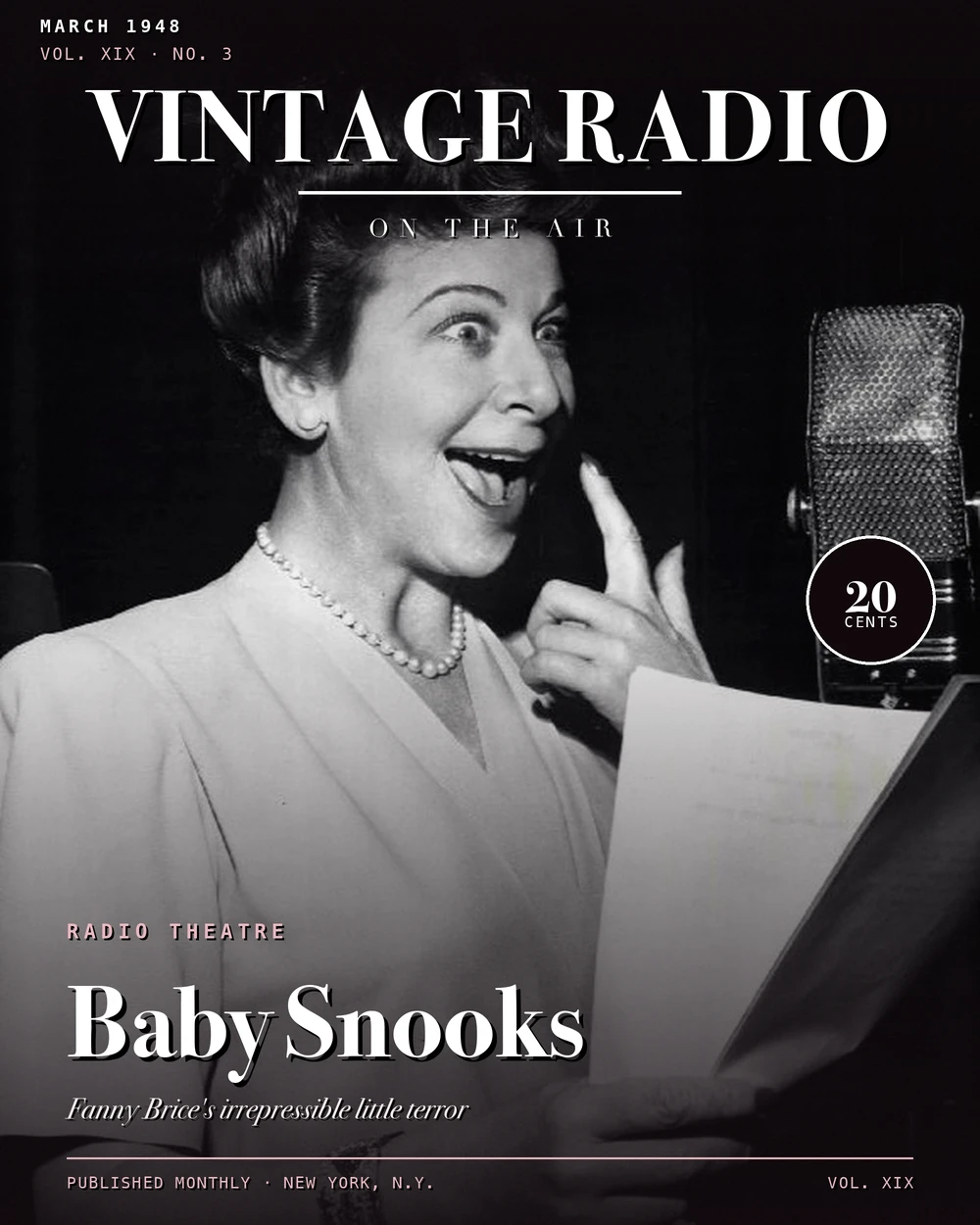
Baby Snooks
The Woman Behind the Little Girl
Fanny Brice — born Fanny Borach on October 29, 1891, on Forsyth Street in New York's Lower East Side — had already lived several careers by the time Baby Snooks became her defining role. She had begged nickels and dimes at Coney Island, singing sad songs with real tears while crowds threw coins. She had won an amateur night at Keeney's Theater in Brooklyn, taking home a $10 prize and gathering $23 more from the stage floor. She had worked briefly for George M. Cohan, who let her go when he discovered she couldn't dance. And she had gotten her break singing "Sadie Salome" in Yiddish dialect at the Columbia Burlesque House — at the suggestion of a struggling young songwriter named Irving Berlin — on a night Florenz Ziegfeld happened to be in the audience.
By 1917, Brice was a major Follies star. Eddie Cantor, who arrived in the Follies that same year, later recalled that she possessed the singular ability to make people laugh and cry at the same time. Her trademark love song "My Man" could break a room's heart; her comic songs from the 1920s — "Secondhand Rose," "Cooking Breakfast for the One I Love," "I'd Rather Be Blue over You (than be happy with somebody else)" — could bring it back to life with laughter. She was a complete performer, and she knew it.
But the character that would outlast everything else she ever did started at a party in 1921. Brice invented Baby Snooks — originally called "Babykins" — as a bit of private amusement, and spent the next decade using it in sporadic stage routines. By 1930 she had brought the character to Broadway in Billy Rose's revue Sweet and Low. By 1934, when the new Ziegfeld Follies opened on Broadway, the Snooks routine was well enough developed that Brice appeared onstage in baby garb and brought down the house. Snooks was, as Brice herself put it, "the kid I used to be" — and at the time she said so, the role was earning her around $3,000 a week.
How Snooks Got to Radio
The earliest radio appearances came in February 1936, when the Snooks routine became a regular part of The Ziegfeld Follies of the Air on CBS, sponsored by Palmolive. That run lasted through early June 1936, and while it gave Snooks a national platform, it was relatively brief.
What followed was a stumble. In the fall of 1936, Brice starred in a short-lived series produced by Frank and Anne Hummert titled Revue de Paree (also called Follies de Paris) on the Blue network's Wednesday schedule at 8:00. She left after 13 weeks, beaten 3-to-1 in ratings by NBC's One Man's Family. It was a reminder that Follies-style variety did not automatically translate to radio, and that even a major theatrical star needed the right vehicle.
The breakthrough came in December 1937, when Brice joined the NBC variety program Good News of 1938 — already two months into its run — as a featured performer. Sponsored by Maxwell House Coffee and positioned by General Foods as a "star-filled spectacular" to compete with Major Bowes' Original Amateur Hour on CBS, the series gave Snooks her first long-running national exposure. Brice was 46 years old when she entered the show. Good News of 1939 cracked the Top Ten in its second season, beating Bowes; Good News of 1940 lost the rematch in its third. When General Foods cancelled the variety hour and dropped its MGM ties, the Thursday night block was split into two half-hours: Maxwell House Coffee Time followed by The Aldrich Family. Both finished in the Annual Top Ten for three consecutive seasons.
When the variety format evolved into Maxwell House Coffee Time in September 1940, Snooks shared a 30-minute program equally with comic Frank Morgan. Morgan did tall-tales monologues during his half; Brice, Stafford, and the rest of the cast performed a quarter-hour Snooks skit in theirs. The two had shared top billing on Good News of 1940, and their pairing grew naturally out of that variety-show format. Over more than three years together, an intense competition developed between them, with each trying to top the other.
When the Maxwell House series ended in 1944, Snooks stepped into a full 30-minute weekly slot as sole star — first on CBS beginning September 1944 under the title Toasties Time (sponsored by General Foods for Post Toasties, Sanka, and Jell-O), and later on NBC from November 1949 through the spring of 1951, sponsored by Tums. The show was still running strong when Brice died.
The Cast That Made It Work
No element of the show mattered more to its week-to-week texture than Hanley Stafford as Snooks's long-suffering father, Lancelot "Daddy" Higgins. Stafford had won the role almost immediately during the Good News period. Brice recalled: "He was perfect — we didn't need to hear anyone else." He was ranked alongside Gale Gordon and Hans Conried as among the best "stackblowers" in radio — the reactors who could steal a scene with pure exasperation — and he erupted at least once per episode as the focus of whatever chaos Snooks had engineered that week.
The rest of the Higgins household filled out over time. Lalive Brownell originally played Mommy Higgins; Lois Corbet took the role in the mid-1940s; Arlene Harris — known to radio audiences as "the human chatterbox" — stepped in after 1945. Leone Ledoux, who had voiced Baby Dumpling on Blondie and handled all the baby roles on The Lux Radio Theater for more than four years, joined the show in 1945 as Snooks's little brother Robespierre. Alan Reed, who had played Daddy Higgins in the earliest 1936 Ziegfeld appearances, returned later as Daddy's boss Mr. Weemish. Danny Thomas played the recurring character Jerry Dingle, a daydreaming postman who each week imagined himself as someone else — Mr. District Attorney, a railroad conductor, the greatest dancer in the world, a circus owner — from 1944 to 1945.
Behind the microphone, the show ran through a long string of capable hands. Producer-directors included Mann Holiner in the early 1940s, Al Kaye in 1944, Ted Bliss, Walter Bunker, and Arthur Stander. Announcing duties passed from John Conte (in the late 1930s and early 1940s) to Tobe Reed (1944–45) to Harlow Wilcox in the mid-to-late 1940s, with Dick Joy, Don Wilson, and Ken Roberts taking turns in the later years. Bob Graham was the vocalist in 1945, and on the CBS run, Clark Casey and David Light handled sound effects. The writers who shaped the Snooks scripts included Phil Rapp, Jess Oppenheimer, Everett Freeman, Bill Danch, Sid Dorfman, Arthur Stander, and Robert Fisher. Music over the years came from Meredith Willson, who served the show roughly from 1937 to 1944, and later Carmen Dragon. The show opened each week to the familiar theme "Rockabye Baby." The Higgins family lived in a place called Sycamore Terrace — a fictional suburban address that could have been anywhere in America, which was probably the point.
What the Character Actually Was
Snooks occupied a particular space among radio's juvenile characters. The show occasionally drew comparisons to Charlie McCarthy and to Junior — Red Skelton's "mean widdle kid" — but Snooks possessed neither the sophistication of Bergen's dummy nor the coarse meanness of Junior. She was impish rather than cruel, mischievous rather than malicious. The comedy came from the specific, inexorable logic of a child who has not yet learned that the world doesn't work the way she thinks it does, applied relentlessly to poor Daddy Higgins.
What made it stranger, and more interesting, was what the character did to Brice herself. As Snooks took hold, Brice's real personality gradually receded. She nearly abandoned her natural voice in public and was seldom seen out of character. After a performance, it could take as long as an hour for her to completely shed the Snooks characteristics. Onstage, she would mug for the microphone, jumping around in her little-girl costume and twisting her face into a broad, goofy grin — performing fully even for a radio audience that couldn't see her. She rarely ad-libbed, but in interviews she referred to "Schnooks" almost as a living person. A new generation came of age knowing Fanny Brice only as Baby Snooks, with no memory of the Follies star, the tragicomic singer, or the woman Eddie Cantor had described as someone who could make you laugh and cry simultaneously.
The penetration into ordinary life ran deep. Comic-book illustrator Graham Ingels and his wife Gertrude named their son, born in 1946, Robespierre — after hearing Leone Ledoux voice Snooks's little brother on the show. That is the sort of detail a Nielsen number cannot quite capture.
Snooks on Screen
For a character that big, it is striking how poorly Snooks translated out of radio. Brice did appear as Baby Snooks onscreen alongside Judy Garland in the 1938 MGM film Everybody Sing, and Snooks proved popular enough that animators reached for the caricature: the 1940 Warner Bros. cartoon Malibu Beach Party features a Brice-as-Snooks stand-in opposite Ned Sparks as Daddy, and the 1946 Warner short Quentin Quail builds a character around the same persona. Walter Lantz, who introduced Andy Panda in the 1939 short Life Begins for Andy Panda, gave the new character a baby voice clearly modeled on Snooks; Andy continued to talk that way through Andy Panda Goes Fishing and 100 Pygmies and Andy Panda (both 1940).
Television was the test that mattered, and Snooks failed it. Brice and Stafford appeared together in character on NBC's The Big Show in the fall of 1950 — Snooks tapped on hostess Tallulah Bankhead's door to ask about an acting career, and later turned up with Groucho Marx in a spoof of You Bet Your Life — but their only TV outing together in character was the June 12, 1950, CBS-TV broadcast of Popsicle Parade of Stars. Brice later admitted the character "just didn't work properly when seen." The bit depended on the audience supplying the mental image of a little girl; once a middle-aged woman in a baby-doll dress was actually visible on a screen, the spell broke. Snooks lived and died on radio because that was the only place she could fully live at all.
How It Ended
In the spring of 1945, Brice missed several episodes at the start of the season due to illness. Rather than simply skip weeks, the show worked her absence into the storyline: Eddie Cantor launched an on-air search for Snooks, with Robert Benchley, Sydney Greenstreet, Peter Lorre, and Kay Kyser joining the effort. Snooks returned on October 7, 1945. It was the kind of production flexibility that illustrated how thoroughly the character had become a fixture — her absence was treated as a news event.
The show remained on the air into May 1951. On May 24 of that year, Fanny Brice suffered a cerebral hemorrhage. She died five days later, on May 29, 1951, at age 59. A memorial broadcast aired that same day. Brice was gone at the height of the show's popularity, with no conclusion to the Snooks storyline and no planned finale — just the abrupt silence that follows when a performer who has become inseparable from a character is suddenly no longer there.
In the years after her death, a different audience found her through Barbra Streisand's film dramatization of her early life, which gave Brice a second posthumous identity as "Funny Girl." That portrayal focused on the Follies years and the marriage to gambler Nicky Arnstein — the world before Snooks. For anyone who had grown up with the radio show, the two Fanny Brices were almost impossible to reconcile. The official honors came too: two stars on the Hollywood Walk of Fame, one for film and one for radio (the radio star at 1500 Vine Street), and a 1991 U.S. Postal Service first-class stamp illustrated by Al Hirschfeld, on which Brice was the only woman in the Comedian Commemorative Issue.
The show itself has been preserved more carefully than most of its era. Phil Rapp's original Baby Snooks scripts are held in the Philip Rapp Collection at the American Radio Archives at the University of California, Santa Barbara, alongside his radio and television materials and correspondence. Jess Oppenheimer's Baby Snooks scripts and production notes — including an unaired pilot titled "The Snooks Show," an unsuccessful attempt to bring the character to television — are at the Writers Guild Foundation Archive in the Jess Oppenheimer Collection. And Rapp's radio scripts have been published in three volumes by BearManor Media, edited by Ben Ohmart: a first collection in 2003, drawing on Maxwell House Coffee Time and Good News of 1938, followed by volumes in 2007 and 2018. The little girl who started at a party in 1921 has outlasted nearly everyone who knew her.